
LADWP Solar Programs Explained: Everything Los Angeles Homeowners Need to Know in 2026
If you are a Los Angeles homeowner served by the Los Angeles Department of Water and Power, you are sitting on one of the most financially rewarding solar opportunities left in California right now. While most of the state’s major utilities gutted their solar export credits years ago, LADWP still credits solar exports at the full retail rate, worth between $0.22 and $0.37 per kilowatt-hour, an advantage that Southern California Edison and PG&E customers lost when NEM 3.0 slashed their export rates by roughly 75%. That single policy difference is the reason why solar in Los Angeles hits payback timelines that simply are not available elsewhere in California.
This guide walks you through every LADWP solar program available in 2026, explains how each one works, and gives you the honest financial picture so you can make a confident decision.
What Is LADWP and Who Does It Serve?
Before diving into programs, it helps to understand who LADWP actually is. LADWP is a municipal utility that serves the city of Los Angeles, as well as parts of Bishop, Culver City, South Pasadena, and West Hollywood. It has operated a solar program for residential and commercial customers across its entire service territory since 1999.
This municipal status matters enormously. Unlike Pacific Gas and Electric, Southern California Edison, or San Diego Gas and Electric, LADWP is not regulated by the California Public Utilities Commission. It sets its own solar policies independently. LADWP has not announced any plans to adopt the Net Billing Tariff structure, making the current retail-rate credit arrangement the baseline for all new residential solar interconnection applications in the city. In other words, the program you enroll in today is the program you keep for the life of your system. The Four LADWP Solar Programs at a Glance
LADWP offers two solar programs for homeowners (net metering and Solar Rooftops) and two programs for renters (Shared Solar and Virtual Net Metering). Here is a full breakdown of each one.
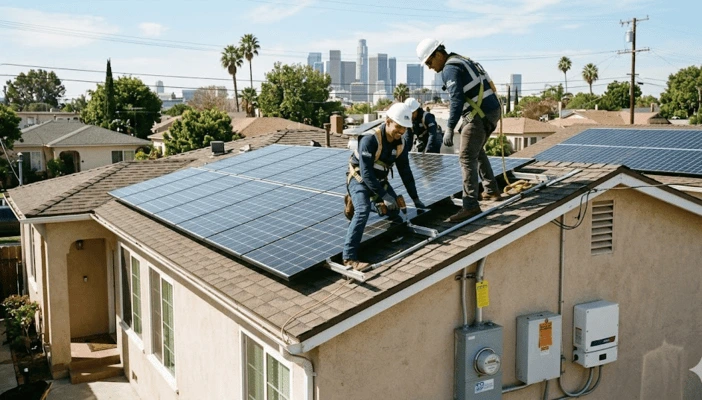
Program 1: Net Energy Metering (NEM) — The Flagship Option for Homeowners
Net Energy Metering is the most popular and financially powerful LADWP solar program for homeowners who own their property and want to own their solar system outright.
How it works
When a solar system generates more energy than a home consumes, the surplus energy is fed back to the grid, and the customer receives net metering credits on their electric bill. This program reduces the overall cost of electricity for residential customers by allowing them to offset their consumption with the energy they generate
When your system is not generating enough power for your home, your electricity will be supplied by the power grid. When your system generates excess power, your meter will run backwards and you receive a credit on your bill.
LADWP’s rates for net metering credits are equivalent to the amount you pay per kilowatt-hour for your electricity. For residential customers, this varies throughout the year and also depends on how much electricity you use in a month.
Why LADWP’s NEM beats the rest of California
This is the part every Los Angeles homeowner needs to understand. LADWP customers who install solar without battery storage still see strong system performance, because retail-rate net metering means every excess kilowatt-hour is credited at the same rate the customer would pay to buy that electricity back. Installers in the LADWP territory commonly cite 6 to 7 years to break even, while SCE customers without batteries routinely see payback periods stretch beyond 12 years
That is nearly a decade faster. On a system that lasts 25 to 30 years, that difference compresses into years of pure profit.
Credits that never expire
LADWP net metering credits roll over indefinitely, so a little extra solar power is not a bad thing. After the $10 minimum monthly charge, a properly sized system can wipe out the homeowner’s full electricity cost and leave them with a rollover credit each year.
While net metering credits can cover the cost of your electricity use, LADWP customers also pay a minimum charge and some adjustment factors. The minimum charge for the Standard Residential Rate is $10 per month plus the Adjustment Factors. That $10 is essentially the cost of staying connected to the grid, which is a small price for the energy security it provides.
System size limits
LADWP does not have a net metering cap for its service territory. However, no individual LADWP customer can apply for net metering with a system larger than 1 megawatt (MW). For a typical Los Angeles home, that ceiling is so high it essentially does not exist.
The interconnection process
Getting connected to the grid requires a few steps. To qualify for LADWP net metering, you must be a residential customer who has installed a qualifying solar power system. The system must be interconnected to the grid and meet certain technical standards set by LADWP.
For systems under 10 kilowatts, a Fast Track Process is available. This means your system does not require panel upgrades, battery backup, or interconnection to other generating systems. You must include photos of your system, then expect approval from the Los Angeles Department of Building and Safety, after which LADWP crews install the two-way meter.
Systems above 10 kilowatts follow the Standard Solar Process, which includes a performance meter test before your system is activated. Either way, the process is well-documented and thousands of Los Angeles homeowners complete it every year.
Program 2: Solar Rooftops Program — Solar Without the Upfront Cost
Not every homeowner wants to spend tens of thousands of dollars on a solar installation. The Solar Rooftops Program (SRP) is designed for people who want the benefits of rooftop solar without carrying the financial burden of ownership.
How it works
The Solar Rooftops Program allows LADWP to install photovoltaic solar systems on the rooftops of customers in exchange for a fixed monthly lease payment between $30 and $75 per month. LADWP owns the system; you provide the rooftop space.
An Energy Storage System may also be added to the PV system for customers who meet additional criteria, in exchange for an additional fixed monthly lease payment of $25 per month, to further increase the reliability of the existing electrical distribution systems.
The goals of the Solar Rooftops Program are to build clean distributed generation across LADWP’s service territory, help modernize and transform the provision of electric service within the city of Los Angeles, and allow LADWP to evaluate the feasibility of implementing an even larger program.
Is this program right for you?
The Solar Rooftops Program is particularly appealing if your roof is newer, structurally sound, and well-oriented for solar production, but you are not in a position to finance or pay cash for a full installation. You earn a lease payment instead of generating personal electricity savings, which is a fundamentally different financial model. If maximizing long-term savings is your priority, owner-occupied net metering is the stronger choice. But if you want to contribute to Los Angeles’s clean energy goals with zero upfront cost and a guaranteed monthly payment, SRP is worth exploring.
LADWP also has the opportunity to couple the Solar Rooftops Program with an energy efficiency component through its Home Energy Improvement Program (HEIP), which provides an energy audit of the customer’s home and deploys skilled labor to apply energy efficiency improvements.
Program 3: Shared Solar — Solar Access for Renters and Non-Traditional Households
For years, solar was only available to people who owned single-family homes with suitable rooftops. The Shared Solar program changed that.
How it works
Through LADWP’s Shared Solar program, renters and homeowners who cannot install rooftop panels can subscribe to a community solar project and receive bill credits at a rate 10 percent below current LADWP prices, locked in for a 10-year term. Royal Solar Solution
This means apartment dwellers, condo owners with HOA restrictions, and homeowners with shaded or structurally limited rooftops can still participate in the economics of solar energy. The subscription connects you to a solar facility somewhere in LADWP’s service area, and the energy it generates flows into the grid on your behalf.
Why the rate lock matters
With electricity rates consistently rising across California, locking in a rate 10 percent below the current LADWP price for a full decade is a meaningful financial commitment. You will not own a solar system, but you will have insulated yourself from rate increases for ten years, which is a real and tangible benefit.
Program 4: Virtual Net Metering — A Path for Multifamily Buildings
Virtual Net Metering (VNEM) is the multifamily counterpart to rooftop net metering. Landlords in LADWP territory can install solar panels on their multifamily properties and help their tenants take advantage of Virtual Net Metering. The solar generation from a single rooftop system gets distributed as credits across multiple tenant accounts, allowing renters in apartment buildings to benefit from solar panels they could never install themselves.
If you are a landlord or property manager in Los Angeles, this program is worth paying close attention to. It adds value to your property, reduces tenant electricity costs, and positions your building favorably in a rental market that increasingly values sustainability.
What Incentives Are Still Available for LADWP Customers in 2026?
The incentive landscape shifted significantly at the end of 2025. Here is an honest summary of what is available right now.
The federal solar tax credit is gone
The 30% Residential Clean Energy Credit (IRC § 25D) expired on December 31, 2025. This credit was repealed by Public Law 119-21, enacted July 4, 2025. Previously eligible costs including panels, inverters, installation labor, permits, and battery storage no longer receive federal subsidies. This effectively increases the upfront cost of solar by approximately 30% compared to systems installed before January 1, 2026.
This is a real change that affects the financial math, and any honest solar company should be upfront about it.
California’s property tax exclusion remains active
California law permanently exempts the added home value from a solar installation from property tax reassessment, meaning a system that raises your appraised value by $20,000 generates zero additional property tax bill.
This exclusion typically saves $200 to $400 per year in avoided property taxes, or $5,000 to $10,000 over the life of the system. The exclusion is automatic when you pull proper permits, so no additional paperwork is required.
The property tax exclusion is set to sunset on January 1, 2027, making it a meaningful reason to move forward with your installation this year rather than waiting.
SGIP battery storage rebates through SoCalGas
The Self-Generation Incentive Program (SGIP) Residential Solar and Storage Equity (RSSE) budget is the only active SGIP pathway in 2026. Funded by $280 million in state dollars under AB 209, it offers $3,100 per kW for paired solar and $1,100 per kWh for storage.
LADWP customers access SGIP through SoCalGas as their program administrator. To qualify for RSSE, you must install a paired solar and battery system or a battery retrofit on an existing solar system, and your household income must be at or below 80% of the Area Median Income, or you must be enrolled in CARE, FERA, or ESA.
That budget is fully reserved as of early 2026, but new applications are accepted on a waitlist and funded as existing reservations cancel. If you qualify on income grounds, getting your application in now puts you in the queue.
Home value appreciation
According to a Zillow study, homes with solar panels sell for approximately 4.1% more than comparable homes without them. In a high-value real estate market like Los Angeles, that premium can translate to tens of thousands of dollars.
How Much Does Solar Cost in Los Angeles Right Now?
The net cost of going solar in LA has increased by roughly 30% compared to systems installed before the end of last year, due to the expiration of the federal Investment Tax Credit. That is a significant shift, and anyone comparing quotes from 2024 to 2025 should recalibrate their expectations. Royal Solar Solution
Based on LADWP’s rate of 22.5 cents per kWh, the estimated installed cost for a typical system falls between $15,000 and $35,000. Where you land in that range depends on your home’s energy consumption, your roof type, your location within the city, and the specific installer you choose.
Despite the higher upfront cost in 2026, the math still holds up because LADWP’s retail-rate net metering compresses the payback period in a way that no other California utility currently offers. Every kilowatt-hour your panels produce is worth full retail value, not a discounted export credit.
LADWP Solar vs. SCE and PG&E: Why Your Utility Matters
If you have neighbors who complain about their solar investment underperforming, there is a good chance they are on SCE or PG&E. A homeowner on SCE who installed solar after April 15, 2023 receives around $0.08 per kWh for exports under NEM 3.0. That gap translates directly into payback speed: LADWP installers commonly cite 6 to 7 years to break even, while SCE customers without batteries routinely see payback periods stretch beyond 12 years.
LADWP is a publicly owned utility, and its rates for residential customers are flat throughout the day. As a result, the value of your net metering credits through LADWP is fixed. There are no time-of-use penalties, no export rate cliffs at midday, and no complicated billing algorithms to navigate.
The California Supreme Court issued a unanimous ruling in August 2025 ordering a Court of Appeal to reconsider whether NEM 3.0 was approved lawfully. Even if that leads to improved export rates for SCE and PG&E customers in the future, it has no direct effect on LADWP’s program, which operates under separate municipal authority. LADWP customers are insulated from that legal uncertainty entirely.
Is Battery Storage Worth It for LADWP Customers?
This is one of the most common questions from Los Angeles homeowners in 2026. The short answer is: it depends on your situation.
With LADWP’s net metering program, you can enjoy savings without needing a costly battery system. This makes it easier and more affordable for Los Angeles residents to save money with solar power.
However, battery storage becomes a very different conversation when you factor in wildfire risk. A solar-only system without battery backup will shut down automatically during a grid outage for safety reasons. Only a solar-plus-battery system configured for backup operation will continue powering your home during an outage. This is a key reason why many Los Angeles homeowners in wildfire-prone areas are pairing their installations with a battery storage system. Royal Solar Solution
For homeowners in hillside communities, Topanga, the Santa Monica Mountains, or any area that has experienced Public Safety Power Shutoffs (PSPS) events, a battery like the Tesla Powerwall, Enphase IQ Battery, or Franklin Electric aPower 2 offers energy independence that pure grid-tied solar cannot provide.
How to Get Started with LADWP Solar
If you are ready to move forward, here is a practical sequence to follow.
Start by reviewing your last 12 months of electricity bills. Your annual kilowatt-hour usage is the single most important input your installer needs to size your system correctly. LADWP customers can access this data directly through their online account portal.
Next, assess your roof. South, southwest, and west-facing roof sections produce the most solar energy in Los Angeles. A roof that is less than 10 years old and in good structural condition keeps your total project cost lower, since you will not need to budget for a re-roof before or during installation.
Get multiple quotes from licensed California contractors who are familiar with LADWP’s interconnection process. The permitting requirements in Los Angeles involve coordination between LADWP and the Los Angeles Department of Building and Safety (LADBS), and an experienced local installer will know how to move through both smoothly.
Ask your installer specifically about your SGIP RSSE eligibility if your household income qualifies. Getting on the waitlist costs nothing and could yield thousands of dollars in battery rebates once funding cycles open up.
Finally, act before January 1, 2027 if you want to lock in California’s property tax exclusion. The January 1, 2027 property tax exclusion sunset means homeowners who delay past that date will not enjoy the same automatic assessment protection on new installations.
The Bottom Line for Los Angeles Homeowners
LADWP solar programs in 2026 give Los Angeles homeowners a set of options that most Californians no longer have access to. Full retail-rate net metering, a zero-cost community solar subscription, a landlord-friendly rooftop lease structure, and a property tax law that prevents solar from raising your assessment all combine into a package that makes the economics of going solar genuinely favorable, even in a post-federal-tax-credit environment.
The federal incentive is gone, and that matters. But LADWP’s billing structure, the California property tax exclusion, the SGIP battery pathway for qualifying households, and Los Angeles’s exceptional solar resource (averaging more than 5 hours of peak sun per day) all add up to a compelling case for homeowners who are serious about controlling their energy costs for the next 25 years.
If you are in the LADWP service territory and you have been on the fence, 2026 is the year to stop waiting. The programs are in place, the policy environment is stable, and the financial logic is sound. The question is not whether solar works in Los Angeles. The question is which program fits your home, your finances, and your goals.