
LADWP Net Metering vs. NEM 3.0: Why LA Homeowners Have a Brilliant Advantage Right Now
Los Angeles homeowners served by LADWP hold one of the most financially rewarding solar positions in all of California right now, and most people have no idea just how big the gap has become. While Southern California Edison and PG&E customers now receive roughly $0.08 per kWh for solar exports under NEM 3.0, LADWP customers still earn credits pegged to the retail rate they would otherwise pay — and that single difference is reshaping the entire math behind going solar in Los Angeles.
If you live within the LADWP service territory, this is the most important thing you can read before making a decision about solar panels. Let’s break down exactly what is happening, why it matters so much, and how you can take full advantage of it before anything changes.
What Is Net Metering and Why Does the Rate You Get Matter So Much
Before diving into the comparison, it is worth understanding the foundation. Net metering is a billing arrangement that lets you send your unused solar energy back to the grid and receive credits on your electricity bill in return. When the sun is shining hard and your panels are producing more than your home consumes, that surplus flows outward. The question is — what is that surplus actually worth?
Under a strong net metering policy, every kilowatt-hour you export is credited at the same retail rate you would pay to buy that electricity back later. Under NEM 2.0, solar exports were credited at the retail electricity rate — the same rate you pay per kWh. Every kWh sent to the grid offset one kWh of future consumption at full retail value, a straightforward one-to-one exchange.
Under a weaker policy like NEM 3.0, the credit you receive for exporting is severed from the retail rate. Unlike classic net metering, the export credit rate is now decoupled from the retail rate customers pay for grid electricity.
That decoupling is the entire story. It is what separates LADWP customers from millions of other Californians in a very real, dollar-measurable way.
What Happened on April 15, 2023 — And Why LADWP Was Not Involved
On April 15, 2023, the California Public Utilities Commission (CPUC) officially replaced NEM 2.0 with NEM 3.0 — technically called the Net Billing Tariff — for customers of the state’s three major investor-owned utilities. Municipal utilities like LADWP and SMUD maintain their own separate policies. NEM 3.0 export rates average around $0.08/kWh compared to approximately $0.30/kWh under NEM 2.0, representing a 75% reduction in compensation.
Here is the critical detail: if you’re in Los Angeles and get electricity from LADWP (LA Department of Water and Power), NEM 3.0 does not apply to you. LADWP runs its own net metering program and currently credits solar exports at full retail rates — a significantly better deal.
LADWP is a publicly owned municipal utility, meaning it operates outside CPUC jurisdiction entirely. LADWP operates a retail-rate net metering tariff under LA City Electric Rate Ordinance 180127. Nobody in Sacramento can force LADWP to slash its solar export rates the way the CPUC forced SCE, PG&E, and SDG&E to do. LADWP sets its own rules, and right now those rules are enormously favorable for solar owners.
The Numbers Side by Side: LADWP vs. NEM 3.0
This is where things get very concrete. Los Angeles homeowners on LADWP have one of the most valuable net metering arrangements left in California in 2026 — full retail-rate credits worth $0.22 to $0.37 per kilowatt-hour that the state’s big three investor-owned utilities cut by 75% three years ago.
Compare that directly to what SCE and PG&E customers receive. Export credits are priced hourly at roughly $0.04 to $0.08 per kWh versus retail rates of $0.30 to $0.35 per kWh.
Let’s put that into a real-world scenario. Imagine your solar system generates 500 kWh of surplus energy in a given month.
Under LADWP net metering at a conservative $0.25 per kWh retail rate, those 500 kWh translate to roughly $125 in bill credits.
Under NEM 3.0 at $0.08 per kWh, those same 500 kWh translate to just $40 in credits.
Same panels. Same sunlight. Same output. A difference of $85 every single month — or over $1,000 every year — simply because of which side of a utility boundary line your home sits on.
How LADWP’s Net Metering Works in Practice
LADWP is a publicly-owned utility, and its rates and prices are flat throughout the day for residential customers. As a result, the value of your net metering credits through LADWP are fixed.
This flatness is actually a significant secondary advantage that people overlook. Under NEM 3.0 with SCE, export credits are time-of-use dependent. Solar panels generate most of their power during midday hours, but peak rates and therefore peak credits occur in the late afternoon and evening. That mismatch means most of your solar export under NEM 3.0 happens precisely when the credits are worth the least.
LADWP sidesteps that problem entirely. Whether your panels push surplus energy to the grid at 10 AM or 2 PM, the credit value stays consistent. You do not need to strategize around time-of-use windows. You do not need to shift your household routines to match a grid pricing schedule. Your panels just work, and you get credited fairly.
If your system produces excess energy, your bill will be credited for the excess power sent back to the grid at a retail rate. These credits never expire. They roll forward month to month, which means your summer surplus carries over into winter months when production dips. That rollover structure is essentially the grid acting as your free battery storage — something NEM 3.0 customers no longer enjoy without purchasing physical battery systems.
The Battery Storage Gap: What NEM 3.0 Customers Are Forced to Do
One of the most revealing ways to understand the LADWP advantage is to look at what NEM 3.0 forced people to do. According to CPUC proceeding data, battery attachment rates among SCE and PG&E solar customers jumped from roughly 11% before April 2023 to nearly 70% by late 2024, because storage became the only way to capture meaningful value from solar generation under the Net Billing Tariff.
That is a massive shift. Batteries went from an optional upgrade to a near-requirement practically overnight. And they are not cheap. Residential battery systems typically cost $10,000 to $15,000 for 10 to 13 kWh of storage capacity after the 30% federal tax credit. While this increases upfront costs, batteries reduce overall payback periods by 3 to 5 years under NEM 3.0.
LADWP customers face none of that pressure. LADWP customers can still use the grid as a virtual battery at full credit value, because their export credits are worth as much as the electricity they would otherwise buy back.
You can absolutely add a home battery to your solar system in LADWP territory — and there are good reasons to do so, including backup power during outages and extra savings at peak times. But you are not financially penalized for skipping it. Your solar installation is complete and financially sound without one. For an SCE customer today, solar without storage is a significantly weaker investment.
Return on Investment: How Much Faster Do LADWP Solar Owners Break Even
The payback period for a residential solar system is one of the most frequently asked questions by homeowners considering the switch. The difference in export credit value has a direct and meaningful effect on that timeline.
Many LADWP customers who install solar see a full return on investment within about seven years. With the combination of LADWP’s NEM credits and government incentives, going solar boosts your home’s value while reducing electricity bills.
Under NEM 3.0, the reduced export credit rates push payback periods longer unless the homeowner adds battery storage. The math simply does not move as fast when your surplus energy earns less than one-third of what it used to.
To explore what a solar installation in your specific situation might cost, and how quickly it could pay for itself, you can get a detailed breakdown at our guide on how much solar panel installation costs in Los Angeles. The numbers are more compelling for LADWP customers right now than they have been in years.
LADWP Service Territory: Are You Actually Covered
Not every address in the greater Los Angeles area falls within LADWP service territory, and this matters enormously before you make any decisions.
LADWP serves most of the City of Los Angeles itself. If you’re in the LADWP service territory — covering most of the city proper, plus parts of West Hollywood, Culver City, and South Pasadena — you hold an advantage that hundreds of thousands of homeowners just outside the city limits no longer have.
Homeowners in Burbank are served by Burbank Water and Power, which has its own separate net metering program. Glendale has Glendale Water and Power. Long Beach has Long Beach Gas and Electric. Pasadena has Pasadena Water and Power. If you live in these areas, you still benefit from municipally owned utility policies that are separate from NEM 3.0, though the specific terms vary. The important group that is unambiguously subject to NEM 3.0’s reduced export rates consists of homeowners served by SCE, typically in the suburban cities and unincorporated county areas surrounding the Los Angeles city core.
If you are unsure which utility serves your address, the fastest way to confirm is to look at your electricity bill header. The utility name appears prominently. If it says LADWP, you are in a strong position.
Federal Tax Credits and LADWP: Stacking the Advantages
The LADWP net metering advantage does not exist in isolation. It stacks on top of federal solar incentives that further strengthen the financial case for going solar in Los Angeles.
The federal Residential Clean Energy Credit has historically provided a 30% tax credit on the installed cost of a solar system. This credit applies regardless of which utility serves your home, but its value is maximized when your solar system also earns strong ongoing credits — which LADWP customers do through their net metering arrangement.
The combination of a substantial upfront tax credit and consistently high-value export credits creates a financial environment for solar adoption in Los Angeles that simply does not exist in most other parts of California right now.
For homeowners ready to move forward, understanding the full process from permit to installation is the next step. Our complete guide to solar panel installation in Los Angeles walks through every stage of the process, from site assessment through grid interconnection with LADWP.
The Legal Landscape: Could LADWP Ever Change Its Policy
It is a fair question to ask whether LADWP might eventually align its net metering program with the CPUC’s NEM 3.0 structure. The honest answer is that nothing currently forces this outcome, but it is worth staying aware of the broader conversation.
NEM 3.0 is also facing active legal scrutiny. In August 2025, the California Supreme Court unanimously sent the CPUC’s decision back to a lower court for further review, siding with environmental groups who argued the commission failed to adequately consider benefits to customers and disadvantaged communities. The policy remains in effect while this review proceeds, but homeowners should track updates as the review unfolds.
If that court review results in improved export rates for SCE and PG&E customers, it would narrow but not eliminate the LADWP advantage. And regardless of how that legal process unfolds, LADWP’s status as a publicly owned municipal utility means any change to its net metering structure would require action at the city level — a separate and slower political process than what governs investor-owned utilities.
The practical takeaway is that the current LADWP advantage is real, it is substantial, and there is no near-term mechanism forcing it to disappear. But the longer a homeowner waits, the less certain that window remains. Solar policy has proven it can change, and it tends to change in ways that reduce homeowner benefits rather than increase them.
Common Questions About LADWP Solar and Net Metering
Does LADWP offer any solar rebates?
LADWP previously had a solar rebate offering, but the program ran out of funds in late 2018. They are not currently offering any rebates or other incentives for new solar customers. The primary financial advantage today comes from the net metering credit structure, not a direct rebate.
What happens to excess credits if I close my account?
The excess bill credits cannot be used to offset taxes or other charges that are not related to energy. If there is credit remaining on your account when you terminate your service, the balance will go to LADWP rather than being paid out in cash. This is worth planning around if you are approaching the end of a billing period with a large surplus.
Do I need a special meter for net metering with LADWP?
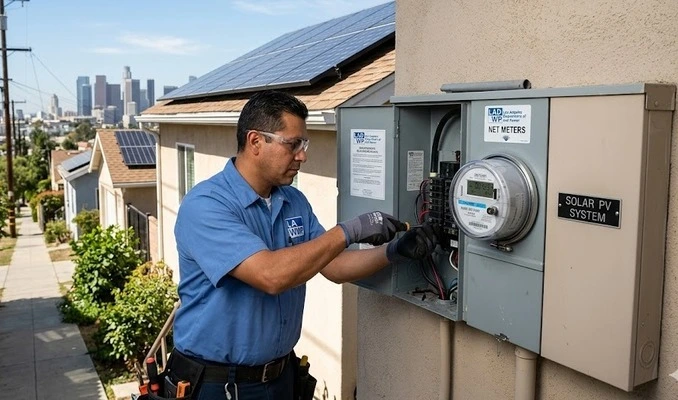
Yes. LADWP installs a two-way meter that tracks both the electricity your home draws from the grid and the surplus your panels send to it. This is a standard part of the interconnection process and your installer will coordinate this with LADWP during the permitting and activation phase.
How long has LADWP offered a solar program?
The Los Angeles Department of Water and Power has operated a solar program since 1999. It is one of the longest-running municipal solar programs in California, which speaks to the city’s long-standing institutional commitment to solar adoption.
Why Right Now Is the Best Time for Los Angeles Homeowners to Go Solar
Every month that passes without a solar system on your roof is a month of electricity bills paid at full rate with no offset. LADWP rates, like rates across California, have been trending upward. Each rate increase makes your eventual solar savings larger — but it also makes every month without solar more expensive.
The combination of factors currently aligned in your favor as an LADWP customer is genuinely unusual:
Full retail rate credits for every kilowatt-hour you export — worth three to four times what NEM 3.0 customers receive. A net metering structure that does not require battery storage to be financially viable. Credits that never expire and roll forward without limit. A federal tax credit that significantly reduces your upfront system cost. A utility that has operated a solar program for over two decades and shows no signs of abandoning its favorable net metering approach.
There is no version of this situation where waiting makes the math better. Rate increases raise your potential savings, yes, but they also raise what you are paying right now. And the policy environment, while currently stable, is never completely static.
Final Thoughts: The LA Solar Advantage Is Real — Don’t Let It Sit Unused
LADWP net metering is not a technicality or a loophole. It is a structurally different and measurably superior compensation system that exists because Los Angeles chose to keep its utility publicly owned. That decision, made generations ago, now translates into thousands of dollars in additional lifetime savings for every LA homeowner who installs solar today versus what a neighbor just outside the city limits would receive from SCE.
The gap between LADWP net metering and NEM 3.0 is not subtle. It is a 75% difference in export credit value. It eliminates the pressure to spend an additional $10,000 to $15,000 on battery storage. It produces faster payback periods and better long-term return on investment.
If your home is served by LADWP and you have been on the fence about solar, this is the clearest possible signal that the conditions are in your favor right now. The window is open. The question is simply how long you intend to wait before walking through it.
Royal Solar Solution provides expert solar panel installation across the Los Angeles area. Reach out today to find out exactly what your LADWP net metering savings could look like based on your home’s specific energy usage and roof configuration.