How to Apply for LADWP’s Solar Rooftop Incentive Program Step by Step
To apply for LADWP’s Solar Rooftop incentive program, you need to download and complete the official PDF application, then mail it or email it to the LADWP Solar Rooftops Program Manager. But before you send anything, there are eligibility boxes to check, program differences to understand, and a few details that can make or break your approval. This guide walks you through the entire process so you go in prepared.
What Is the LADWP Solar Rooftop Incentive Program?
The Los Angeles Department of Water and Power (LADWP) offers several solar programs for residential customers, and it helps to know which one fits your situation before you start filling out forms.
The Solar Rooftops program is specifically designed to expand access to solar participation for qualified LADWP residential customers who otherwise might not be able to participate due to the high cost of installing panels. Participation also enables customers to help LADWP modernize its grid and support the creation of a cleaner Los Angeles.
In simple terms, LADWP owns the solar panels, installs them on your roof at no upfront cost to you, and pays you a monthly lease amount in return. You get reduced electricity bills and a passive income stream without the large capital investment that typically comes with rooftop solar.
This program is separate from the older Solar Incentive Program (SIP), which has since run out of funds and is no longer accepting new applications. So if you have been hearing about LADWP solar rebates and wondering whether they still exist, the Solar Rooftops program is the current pathway for most residential customers.
Who Qualifies for the Solar Rooftops Program?
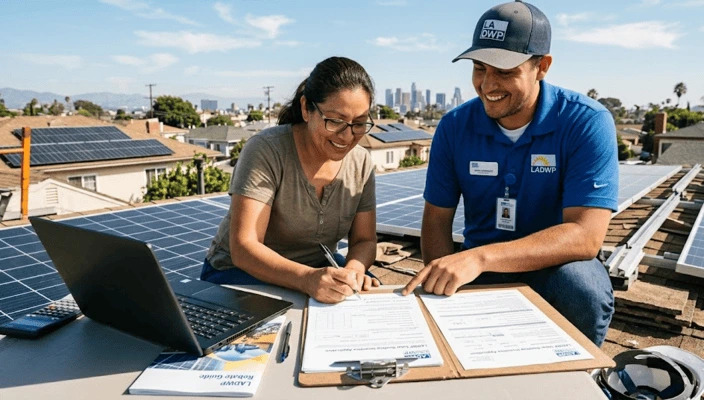
LADWP Solar Rooftop Incentive Program Before anything else, make sure you meet the eligibility requirements. Applying without qualifying is just wasted time.
To qualify, customers must be located in the LA service area, be on a residential rate schedule (R1-A, R1-B, R1-D, or R1-E), and must not have participated in LADWP’s Solar Incentive Program. The home must be owner-occupied and able to satisfy LADWP evaluations and other criteria, such as the age, size, and shape of the roof.
Additional disqualifiers listed in the official program guidelines include:
Applications must be fully completed and signed by the primary LADWP customer account holder and homeowner. If an application contains two different persons listed as the customer account holder and homeowner, it may be delayed or disqualified. The applicant’s home must also be located in the Los Angeles Basin of LADWP’s service territory.
So if you are renting, the Solar Rooftops program is not for you. Renters do have an alternative, which is the Shared Solar Program, where participants can lock in a fixed rate for solar-generated kilowatt-hours for up to ten years.
The Low-Income Path: SGIP Solar and Battery Program
If your household income qualifies, there is an even more generous program available through the State of California’s Self-Generation Incentive Program (SGIP), administered locally by LADWP.
The SGIP is a State of California initiative that provides funding for income-qualified residential customers to install solar and battery storage systems on residential property. Solar panel systems provide residents with the ability to generate their own electricity, while battery storage systems can store electricity for use during peak rate periods or in the evenings when solar production decreases.
Single-family households making 80% or less than the area median income are eligible for LADWP’s solar plus battery storage program. That means a family of four in Los Angeles making $121,150 or less would qualify. For apartment buildings, at least five of the units must be low-income and located in a pollution-burdened community, or at least 80% of the households in the building must have incomes at or below 60% of the area median income.
Depending on which category a customer is eligible for, they can receive $1,100 per kilowatt-hour of storage and $3,100 per kilowatt of solar. The average single-family household is expected to install a 15 kWh battery and a 5 kW solar system.
This SGIP pathway essentially covers the full cost of installation for qualifying households, making it one of the most powerful solar access programs in California right now.
Step by Step: How to Apply for the Solar Rooftops Program
Here is the exact process for applying to the standard Solar Rooftops program as an eligible LADWP residential customer.
Step 1: Confirm Your Eligibility
Go through the checklist above first. Verify that you are on a qualifying residential rate schedule, that you own and occupy the home, and that you have not previously enrolled in the Solar Incentive Program. If you are unsure of your rate schedule, log in to your LADWP online account or call customer service before proceeding.
Step 2: Download the Application Form
Download, print, and complete the PDF application from the LADWP website. Once complete, mail it to: LADWP Solar Rooftops Program Manager, 111 N. Hope Street, Room 968, Los Angeles, CA 90012. Or you can scan the completed application and email it to
Make sure every field is filled in completely. Incomplete forms are a common reason for delays.
Step 3: Wait for Evaluation and Queue Placement
A queue management database is used to accept all applications. Once your application is received and verified, it enters the queue. Given the demand for this program, waiting times can vary. Be patient and keep a copy of your submitted application for your records.
Step 4: LADWP Designs and Permits Your System
Once your spot in the queue is reached, LADWP takes over the heavy lifting. LADWP designs the solar panel package and pulls a permit from the Los Angeles Department of Building and Safety (LADBS). You do not need to hire a contractor or navigate permitting on your own for this program.
Step 5: Installation and Inspection
LADWP installs the solar panel system, which ranges from 1 to 10 kW, and LADBS then inspects and approves the installation. The system is then connected to LADWP’s grid.
Step 6: Start Receiving Monthly Payments
Once your system is live and grid-connected, the lease agreement kicks in. Under the Solar Rooftops program, you essentially become a landlord for solar panels owned by LADWP. In exchange for the use of your roof, you will receive a monthly payment of between $20 and $50, depending on the size of the solar installation your roof can fit. The Solar Rooftops agreement lasts for 20 years, meaning it can earn participating homeowners between $4,800 and $12,000 over the agreement term.
Step by Step: How to Apply for SGIP (Income-Qualified Customers)
If you are pursuing the SGIP route for free solar and battery storage, the process is a bit different.
Step 1: Verify Income Eligibility
Eligible single-family households must provide documentation demonstrating that total household income is at or below 80% of the Area Median Income (AMI), verified through the most recent available federal income tax documentation.
Step 2: Find an Approved SGIP Solar Developer
Solar developers will generally submit the application, so interested customers should first identify an approved contractor. Applications will remain open until funding runs out. You can find the searchable list of approved developers on the LADWP SGIP program page and at selfgenca.com.
Step 3: Submit Through the SGIP Portal
The applications are submitted on the SGIP application database website at A SGIP-approved developer will typically draft and submit an application on behalf of their customers.
Step 4: Complete Income Verification Documents
Your developer will walk you through gathering the required documentation. This typically includes recent tax returns and any additional verification forms required by LADWP or the CPUC.
Step 5: Installation and Incentive Processing
Once approved, your developer schedules installation. The SGIP Advanced Payment Program offers 50% of the SGIP incentive upfront so the customer does not pay any costs out of pocket until the system has been installed and the full SGIP incentive received.
Additional Solar Incentives That Stack With These Programs
One of the smartest moves you can make is to combine the LADWP program with other available incentives.
Federal Investment Tax Credit (ITC): The Inflation Reduction Act extended the 30% federal solar tax credit through 2032. Even if LADWP owns the panels under Solar Rooftops, if you go the owner-occupied solar route through an installer, you can claim this credit on your federal return.
Net Energy Metering (NEM): LADWP was not subject to recent state-level cuts to rooftop solar incentives called net energy metering, so customers will still get paid back for electricity they generate or store on their new systems at the full rates they pay. This makes going solar with LADWP more financially favorable than with many other California utilities.
California SGIP Battery Incentive: Even without going through LADWP directly, homeowners with existing solar can potentially pair a new battery storage system with SGIP incentives, reducing or eliminating the cost of storage.
What Happens After You Apply
Many applicants submit the form and then hear nothing for weeks. This is normal. The Solar Rooftops program has had consistent demand, and the queue can be long. Here is what you should do in the meantime.
First, confirm your application was received. If you emailed it, a read receipt or a quick follow-up email to is reasonable. If you mailed it, send it with tracking.
Second, review your current electricity usage. The size of the system LADWP installs on your roof is partly determined by what your roof can accommodate and what LADWP needs for grid purposes. Understanding your own usage patterns through your LADWP account helps you ask better questions when they reach out.
Third, check whether your roof needs any maintenance before installation. Older roofs or those needing repairs could cause complications during the LADWP evaluation.
Cities Served and Where to Start Your Solar Journey
LADWP’s service area covers the City of Los Angeles and surrounding incorporated communities. Whether you are in the heart of the city or in one of the nearby areas, a qualified local solar company can help you navigate not just LADWP programs but also city permitting, HOA requirements, and system sizing.
If you are considering a privately owned rooftop solar installation alongside or instead of the LADWP Solar Rooftops program, working with an experienced local installer makes the process faster and smoother. For homeowners across Los Angeles, you can learn more about the full process at our solar panel installation in Los Angeles, CA page.
Homeowners in the Pasadena area have access to similar programs and utility coordination, and our team covers that region as well. See our solar panel installation in Pasadena, CA page for local details.
We also serve customers in Glendale, where the local utility landscape has its own nuances. Visit our solar panel installation in Glendale, CA page to see what applies to you.
In Burbank, solar adoption has been growing steadily. Our solar panel installation in Burbank, CA page covers what Burbank homeowners should know before going solar.
And if you want to understand the real cost of going solar in the region before committing to any program or installer, take a look at our guide on how much solar panel installation costs in Los Angeles, CA.
Frequently Asked Questions
Is the LADWP Solar Incentive Program still accepting applications?
No. Solar Incentive Program funds are no longer available for new applications. The Solar Rooftops program and SGIP are the active pathways for most residential customers today.
Does the Solar Rooftops program work for renters?
No. The program requires owner-occupied single-family homes. Renters in multifamily buildings can look into the Shared Solar Program instead.
Can I apply for both Solar Rooftops and SGIP?
Customers that are currently enrolled with the Solar Incentive Program or have an existing PV solar system are not eligible for the Solar Rooftops Program. If you already have solar, SGIP battery-only applications may still be available depending on your eligibility.
How long does the Solar Rooftops program agreement last?
The lease agreement runs for 20 years, during which LADWP owns and maintains the equipment on your roof and you receive monthly payments.
What system size can I expect?
LADWP will install a PV solar system ranging from 1 to 10 kW on a customer’s rooftop. If an energy storage system is integrated with the PV solar system, the storage size in kW shall be less than or equal to the PV solar system size.
Final Thoughts
Applying for LADWP’s Solar Rooftop Incentive Program is straightforward once you understand which program applies to you. The Solar Rooftops program is ideal for homeowners who want solar access without the upfront cost, while the SGIP is a powerful option for income-qualified households looking for fully funded installation. Either way, the City of Los Angeles continues to be one of the better environments in the country for residential solar, especially given that LADWP has maintained strong net metering terms that many other California utilities have walked back.
Start by downloading the application, double-checking your eligibility, and reaching out to a local solar professional who knows the LADWP process inside and out. If you have questions about costs, system sizing, or the permitting process in your specific city, our team is here to help.