Solar Panel Installation in Long Beach CA: Complete Local Guide
Solar panel installation in Long Beach CA is one of the smartest financial decisions a homeowner can make right now. With over 263 sunny days per year, some of the highest residential electricity rates in the country, and a city government that actively streamlines the permitting process, Long Beach sits in a uniquely favorable position for going solar. Whether you live in Belmont Shore, Bixby Knolls, Signal Hill, or Naples Island, this guide covers everything you need to know, from the true local costs and permits to incentives, utility rules, and how to choose the right installation company.
Why Long Beach Is One of California’s Best Markets for Solar
Long Beach occupies a sweet spot that most cities in America cannot match. The coastal Mediterranean climate keeps average temperatures mild year round, which actually works in your favor when it comes to solar panel efficiency. Panels in Long Beach operate closer to their rated efficiency than in hotter inland communities, where summer heat noticeably reduces output. Heat is the silent enemy of photovoltaic output, so the ocean breeze that residents sometimes take for granted is quietly keeping solar production high.
Beyond the climate, electricity costs are a major driver. California electricity prices increased 56% from 2020 to 2024, and Long Beach homeowners are increasingly turning to solar energy as a practical way to take control of rising energy costs. When you pair that trend with the fact that SCE’s average rate sits at 34.5 cents per kWh, hitting $0.59/kWh during the summer peak window between 4 and 9 PM, it becomes clear that every kilowatt-hour you generate yourself carries real dollar value.
The city itself has been on board with solar for years. Long Beach Airport installed solar trees as far back as 2008, and the city’s downtown parking facilities added solar canopies in 2021. That institutional commitment filters down to how the city handles residential permits, which is a genuine advantage for homeowners ready to make the switch.
How Much Does Solar Panel Installation Cost in Long Beach?
Cost is usually the first question homeowners ask, and the honest answer is that it depends on your system size, your roof type, and whether you add battery storage. That said, real local data gives a useful baseline.
Based on current marketplace data, the average Long Beach homeowner needs an 8.13 kW solar panel system to cover their electric bills, at an average cost of around $19,290 before any available incentives, translating to roughly $2.37 per watt.
Breaking it down further by system size, a typical 7 kW system in Long Beach costs approximately $17,010 before incentives, an 8 kW system runs around $19,440, and a 10 kW system comes in at roughly $24,300.
After accounting for all available incentives (covered in detail below), your out-of-pocket cost drops considerably. Current market data points to an average payback period of about 8.9 years and approximately $104,000 in projected 25-year savings for Long Beach homeowners.
These figures are not hypothetical. They come from actual installations in Los Angeles County, and they reflect what homeowners on SCE’s rate schedule are realistically saving once their systems are live.
Solar Incentives and Tax Credits Available to Long Beach Homeowners
Understanding your incentives before you sign anything is critical because they directly determine your return on investment.
Federal Investment Tax Credit (ITC)
This is the big one, but its availability has recently changed. The federal homeowner tax credit was eliminated in January 2026 for cash or loan purchases. Through a lease or PPA, the installer claims the Section 48E credit through 2027 and passes the savings on through lower monthly payments. If you are planning a cash purchase or financing through a solar loan, factor this change into your calculations. If you are leaning toward a lease or PPA structure, the savings are still accessible through the installer.
California Property Tax Exclusion
California exempts the added value of a solar energy system from your property tax assessment. This means installing panels increases the market value of your home without increasing your annual property tax bill, which is a meaningful financial advantage that compounds over time.
DAC-SASH Program for Income-Qualified Homeowners
The DAC-SASH program offers an incentive worth $3 per watt for solar panel systems between 1 and 5 kW. To qualify, you must meet income requirements and own a single-family home in a top 25% disadvantaged community served by SCE. Through May 2026, income limits are $52,875 for a one-to-two person household and $94,125 for a five-person household. If you think you may qualify, contacting GRID Alternatives is a good first step.
SCE Net Billing Tariff (NEM 3.0)
SCE switched to NEM 3.0, also called the Net Billing Tariff, in April 2023. Under this structure, midday solar export earns approximately $0.05 to $0.08 per kWh, while the peak rate sits at $0.59/kWh between 4 and 9 PM during summer. That gap is significant. The practical implication is that simply sending excess power to the grid during the day and buying it back at night is no longer an efficient strategy. Pairing solar with battery storage is strongly recommended for SCE customers to maximize self-consumption and offset the lower export rates under NEM 3.0.
PACE Financing
California is one of only three states that offers property assessed clean energy financing to homeowners, which means you can finance your solar installation through your property tax bill rather than taking out a personal loan. Eligible products can be financed for up to 25 years depending on the useful life of the system.
Understanding SCE’s Net Billing Tariff: What It Means for You
If you are a Southern California Edison customer, and most Long Beach homeowners are, the Net Billing Tariff is the framework that governs how your solar system interacts with the grid. It is worth understanding in plain terms.
With net billing, the value of surplus solar energy is based on what your utility pays for electricity at the wholesale rate, not what you pay at the retail rate. Because the wholesale value fluctuates with supply and demand, your exact compensation will vary depending on the hour of the day, day of the week, and the month you export your energy.
This is a fundamentally different dynamic than the older net metering programs that credited exports at full retail value. The most effective response to this structure is to maximize how much solar energy you consume directly in your home, with a battery system storing what you cannot use during the day so you can draw from it during the expensive evening peak hours instead of buying from SCE.
A California court upheld NEM 3.0 in March 2026, making this the permanent structure to plan your self-consumption strategy around. This is not a temporary policy in limbo. It is the system you need to design your installation around from day one.
The Solar Permitting Process in Long Beach
One area where Long Beach genuinely stands out is its permitting infrastructure. The city has invested in digital systems that make the permit process faster and less frustrating than in many neighboring jurisdictions.
The City of Long Beach is committed to encouraging and supporting the installation of rooftop solar PV systems, permitting these installations by reviewing, approving, and issuing most construction permits electronically through the city’s online portal.
The City of Long Beach offers streamlined online permitting for residential solar systems under 10 kW. Qualifying systems are typically processed in about 3 business days, with permit fees running between $250 and $500.
Here is how the full process typically unfolds once you engage a qualified installer:
First, your installer evaluates your home’s energy usage, roof condition, and sun exposure, and prepares a detailed proposal. Next, the design is finalized, accounting for your roof’s orientation, any shading from nearby trees or structures, and Long Beach’s coastal solar production profile. The installer then files for a city permit and submits your SCE interconnection application simultaneously. Once the permit is approved and the physical installation is complete, a city inspector visits to approve the work. SCE then provides Permission to Operate. The total timeline from contract signing to system activation typically runs between 4 and 8 weeks.
How Long Does the Physical Installation Take?
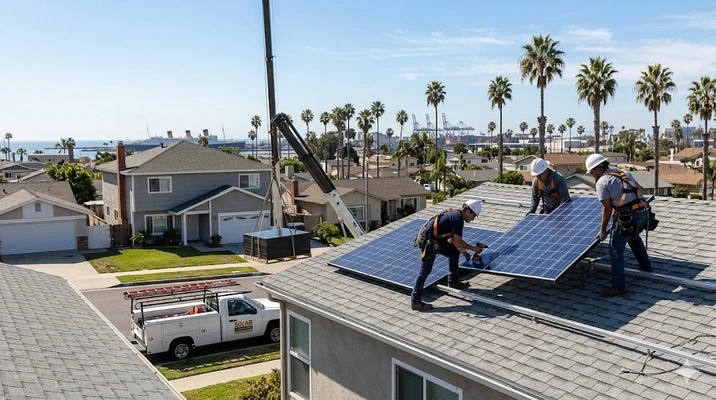
Once permits are in hand, the physical installation itself moves quickly. Solar panel installation typically takes place over one to three days. Installation day includes preparing the roof with racking, setting up wiring, placing the panels and inverters, and connecting everything together.
After the installation is physically complete, a representative from the city government inspects the system and provides approval for interconnection with SCE. For most residential systems, this inspection is a routine step with predictable timelines.
Should You Add Battery Storage?
Given Long Beach’s utility structure under NEM 3.0, battery storage has moved from optional to essentially essential for homeowners who want to maximize their return on investment. The logic is straightforward. Your panels produce the most power between roughly 10 AM and 3 PM, when SCE’s export rates are at their lowest. The hours when electricity is most expensive are between 4 and 9 PM in summer, when the sun is already lower or setting. Without a battery, you export cheap and buy expensive. With a battery, you store the midday surplus and discharge it during the peak window.
Popular battery options installed alongside solar systems in Long Beach include the Tesla Powerwall and Enphase IQ Battery series, both of which integrate cleanly with residential solar arrays and come with dedicated energy management software. Both systems allow you to set preferences around when to charge, when to discharge, and how much reserve capacity to maintain for backup power during grid outages.
Grid reliability is another reason Long Beach homeowners increasingly pair batteries with solar. Aging grid infrastructure in Southern California means outages, while infrequent, do happen. A battery-backed solar system keeps essential loads running during those events without any action required from you.
Choosing the Right Solar Installer in Long Beach
Selecting the right company to do the work matters as much as selecting the right panels. Here are the specific factors to evaluate when comparing installers:
Licensing and certification. Any contractor working on your roof and your electrical system in California must hold a valid C-46 or C-10 contractor’s license from the California Contractors State License Board (CSLB). Verify this independently before signing anything.
Experience with SCE’s rate structures. Long Beach is exclusively SCE territory for most neighborhoods, and a company that understands the nuances of NEM 3.0, Time-of-Use rate plans, and how to size battery storage accordingly will deliver a better-performing system than a company applying a generic design.
Roof and coastal climate experience. Long Beach’s proximity to the Pacific Ocean means salt air exposure, which affects both mounting hardware and panel longevity over time. Installers familiar with coastal installations use appropriately rated materials and mounting systems.
Warranties. Look for a company offering at minimum a 10-year workmanship warranty on the installation itself, separate from the manufacturer warranties on the panels (typically 25 years for production guarantees) and inverters (typically 10 to 12 years standard, up to 25 years with extended coverage).
Transparent, itemized proposals. A trustworthy installer provides a detailed proposal that breaks out equipment costs, labor, permit fees, and projected production in kilowatt-hours per year, alongside realistic estimates of your SCE bill reduction.
It is wise to get a detailed estimate, contract, and warranty in writing before any work begins, and to avoid companies offering the cheapest quotes, as quality tends to suffer. Never pay in full before the project starts; follow a staged payment plan instead.
Solar Across Long Beach Neighborhoods
The diversity of Long Beach’s housing stock means installation considerations vary by neighborhood. Here is a quick look at what to expect in different parts of the city:
Belmont Shore and Naples Island feature older, smaller lots with a mix of rooflines. Roof orientation and available square footage are key considerations here. East-facing and west-facing arrays can still produce very well in these neighborhoods, and microinverters are often recommended over string inverters to handle any partial shading from neighboring buildings.
Bixby Knolls and Los Cerritos offer more generous rooflines with south-facing exposure, making them among the most straightforward and high-producing installations in the city.
Signal Hill, technically a separate incorporated city within Long Beach, offers elevated positioning that can increase sun exposure and reduce shading, making it particularly attractive for solar.
North Long Beach neighborhoods tend to have slightly older housing stock, which may require a roof evaluation or reinforcement assessment before installation, especially for tile roofs common in the area.
Downtown Long Beach condominiums and multi-unit buildings fall under different rules. Commercial and multi-family installations require additional review through the city’s permitting process and may involve more complex interconnection agreements with SCE.
Financing Options for Going Solar in Long Beach
You do not have to pay cash upfront to go solar in Long Beach. The main financing paths available today include:
Cash purchase. The highest upfront cost but the best long-term return. With the federal ITC no longer available for cash buyers as of early 2026, the economics still work well given SCE’s high retail rates, but the payback period will be somewhat longer than it was in prior years.
Solar loan. Zero or low down payment options through solar-specific lenders or your bank allow you to own the system and build equity in it. Monthly loan payments are typically offset by reduced SCE bills from day one.
Power Purchase Agreement (PPA). In Long Beach, residents served by Southern California Edison can access PPAs, where you pay only for the electricity your solar panels produce at a set rate per kilowatt-hour, typically lower than utility rates, with no large upfront investment and the installer handling all maintenance and monitoring.
Solar lease. Similar to a PPA but structured as a fixed monthly payment rather than a per-kWh charge. The installer owns the system, which means they can claim the ITC and pass savings to you through lower monthly costs.
PACE financing. Repaid through your property tax bill over a long term, which can make upfront costs effectively zero while keeping the system ownership in your hands.
What to Expect After Your System Goes Live
The day SCE grants your Permission to Operate is the day your investment starts generating returns. Your installer should set you up with a monitoring app, either through your inverter manufacturer (Enphase Enlighten, SolarEdge monitoring, or Tesla app if you have a Powerwall) that shows real-time production, consumption, and any system alerts.
In the first few months, review your SCE bill carefully. You will be on a Time-of-Use rate plan, and understanding when you draw from solar versus the grid helps you optimize habits like running dishwashers and washing machines during peak solar production hours rather than in the evening.
Annual production in Long Beach averages out well thanks to the city’s 5.6 peak sun hours per day. Minor dips in output during the marine layer season (typically June and July mornings, often called “June Gloom”) are normal and temporary. Your annual production numbers will still align closely with what your installer projected.
Most quality installers recommend a system inspection every three to five years to check racking hardware, wiring connections, and panel surfaces, particularly in coastal environments where salt deposits can accumulate.
Common Questions About Solar Panel Installation in Long Beach CA
Does my homeowners association need to approve solar panels? California law under the Solar Rights Act significantly limits an HOA’s ability to prohibit solar installations. HOAs can impose reasonable aesthetic guidelines, such as requiring panels to be placed out of street view where technically feasible, but they cannot outright deny solar permission.
Can I go solar if I have a flat roof? Yes. Flat and low-pitch roofs are completely compatible with solar, and mounting systems that tilt panels at an optimal angle for Long Beach’s latitude are standard practice.
What happens during a power outage? A standard grid-tied solar system without battery storage will automatically shut down during a grid outage for safety reasons. A solar-plus-battery system can be configured to island your home from the grid and keep essential circuits powered during outages.
How do I know if my roof is in good enough condition? Any reputable installer will assess your roof before finalizing a proposal. If your roof has fewer than 10 years of useful life remaining, it is generally advisable to re-roof before installing panels to avoid the cost of removing and reinstalling the array later.
What panel brands are best for Long Beach’s coastal environment? Tier-1 panel manufacturers with strong performance warranties and corrosion-resistant frames are the right choice for coastal climates. Brands like Maxeon, REC, and Q CELLS are frequently specified for Long Beach installations due to their durability and efficiency in real-world coastal conditions.